
Views: 0 Author: Site Editor Publish Time: 2026-08-18 Origin: Site


Oil filters may look similar in appearance, but their quality can vary greatly depending on the filter media, filtration performance, sealing design, and manufacturing process. These differences directly affect how well the filter protects the engine and how long it can maintain stable performance.

For automotive parts wholesalers, distributors, and buyers, selecting the right oil filter is not only about finding a competitive price, but also consider product consistency, fitment precision, supply reliability, and customer feedback. Choosing a reliable oil filter supplier can also help reduce after-sales risks and improve long-term business competitiveness.
So, how do you select a high-quality oil filter for automotive applications?
In this article, we will explore the main factors that define automotive oil filter quality, including filter media, filtration efficiency, structural design, and supplier capabilities.
The filter medium is the key factor determining the performance of an oil filter. When purchasing, attention should be paid to filtration efficiency, dirt-holding capacity, and durability.
Common types of oil filter media include:
Filter Media Type | Features |
Cellulose Media | Cost-effective with reliable filtration performance for standard applications. |
Synthetic Media | Higher filtration efficiency and longer service life for demanding applications. |
Synthetic Blend Media | Balances performance and cost by combining cellulose and synthetic materials. |

Cellulose Media

Synthetic Media

Synthetic Blend Media
Filtration efficiency determines an oil filter's ability to remove contaminant particles. High-quality oil filters should provide effective contaminant removal while maintaining proper oil flow rate and controlling pressure drop.
High-quality sealing rings and precision dimensional design ensure effective sealing, thereby reducing the risk of oil leakage and lowering after-sales costs.
For spin-on oil filters, the quality of the filter housing must also be considered. This includes:
Housing strength
Pressure resistance
Corrosion resistance
A high-quality filter housing helps alleviate stress on the filter during operation in high-temperature and high-pressure environments.

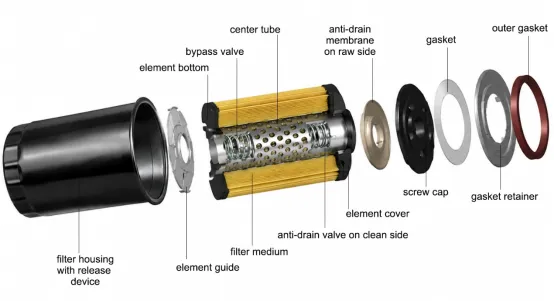
Filter element valves are primarily divided into two types.
Bypass Valve: Allows oil to continue flowing when the filter is clogged or during cold starts, preventing insufficient lubrication and reducing the risk of engine damage.
Anti-Drainback Valve: Prevents oil from flowing back after the engine is turned off, helping the engine receive lubrication faster during the next startup.
Comparison | High Quality Oil Filter | Low-Cost Oil Filter |
Filter Media | Uses high-quality filter materials | Uses lower-cost materials |
Filtration Performance | Stable and reliable filtration | Performance may vary |
Sealing Performance | Reliable sealing performance | Higher risk of leakage |
Service Life | Longer service life | Shorter service life |
Customer Satisfaction | Higher customer satisfaction | More after-sales issues |
For wholesalers and distributors, product quality is the primary consideration; consistent quality reduces after-sales costs and boosts customer repurchase rates.

Compared to filters from the original brand, OE-grade replacement oil filters more easily meet the installation and performance requirements of the target vehicle models. They provide:
Designed for OE-compatible fitment and performance requirements
More competitive pricing
More flexible procurement options
Reliable supply capabilities
For overseas automotive parts buyers, OE-quality aftermarket oil filters provide a better balance between product performance, purchasing costs, and profit margins.
Part Industry focuses on supplying OE-quality automotive filters with stable manufacturing processes and flexible OEM/ODM solutions, helping global aftermarket customers build reliable and competitive product lines.
Buyers should check filter media, filtration efficiency, sealing performance, fitment accuracy, and manufacturing quality to ensure reliable performance and durability.
A quality oil filter should provide effective contaminant removal while maintaining proper oil flow rate and avoiding excessive pressure drop.
Cellulose media: Cost-effective and suitable for standard applications.
Synthetic media: Provides higher filtration efficiency, better dirt-holding capacity, and longer service life.
Distributors should evaluate suppliers based on manufacturing capability, quality control, OE fitment accuracy, supply stability, export experience, and OEM/ODM support.
Choosing a high quality oil filter requires more than comparing prices. Buyers should consider key factors such as filter media, filtration efficiency, sealing performance, valve design, fitment accuracy, and supplier capability to ensure reliable product performance.
For automotive distributors and wholesalers, OE replacement oil filters provide a practical balance between OE-level quality, competitive pricing, and stable supply. Partnering with a reliable oil filter supplier can help reduce after-sales risks and support long-term business growth.
If you would like to obtain high-quality oil filters immediately, please contact Part Industry, our professional team will provide the right products based on your needs.


