
Views: 0 Author: Site Editor Publish Time: 2026-11-24 Origin: Site


Forged steel control arms are suspension components with arm bodies formed by plastically deforming steel under compressive forces. Properly controlled forging can produce favorable grain-flow patterns in load-bearing sections, contributing to fatigue resistance under repeated suspension loads.
Their durability depends on steel grade, grain-flow orientation, heat treatment, structural geometry and manufacturing quality. For heavy-duty applications, component-level testing is necessary to verify performance against the intended load requirements.
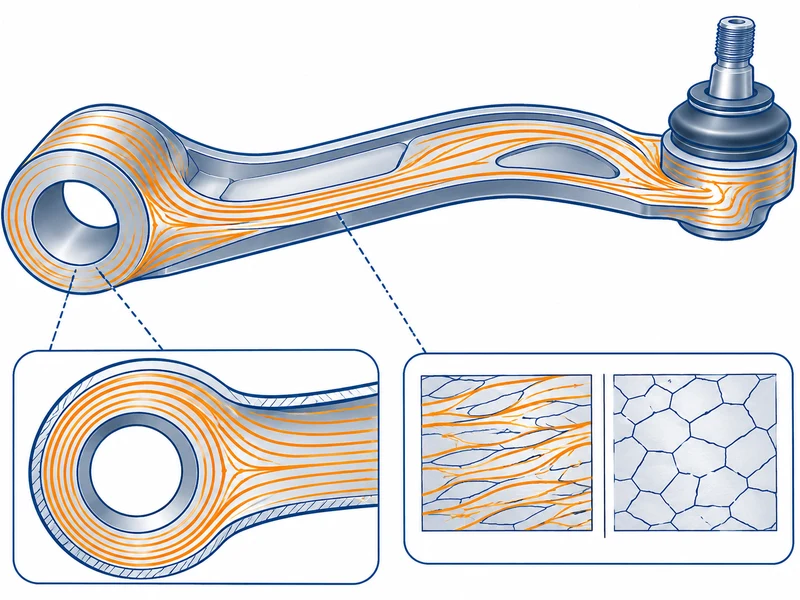
During hot forging, the deformation of steel changes its internal directional structure. Inclusions and segregation patterns may become elongated along the material flow, creating a fibrous pattern visible in macroetched sections.
Grain flow differs from grain size. The former describes directional material structure, while the latter describes the dimensions of individual grains.
For forged steel control arms, three areas deserve particular attention:
Bushing mounting eyes: Material flow and machining around the mounting openings.
Ball joint connection: Local geometry and structural integrity around the joint interface.
Section transitions: Fillet radii and changes in thickness that influence stress concentration.
Continuous, suitably oriented grain flow can support fatigue resistance. However, unfavorable flow orientation, surface decarburization, forging folds and inappropriate heat treatment may reduce this benefit.
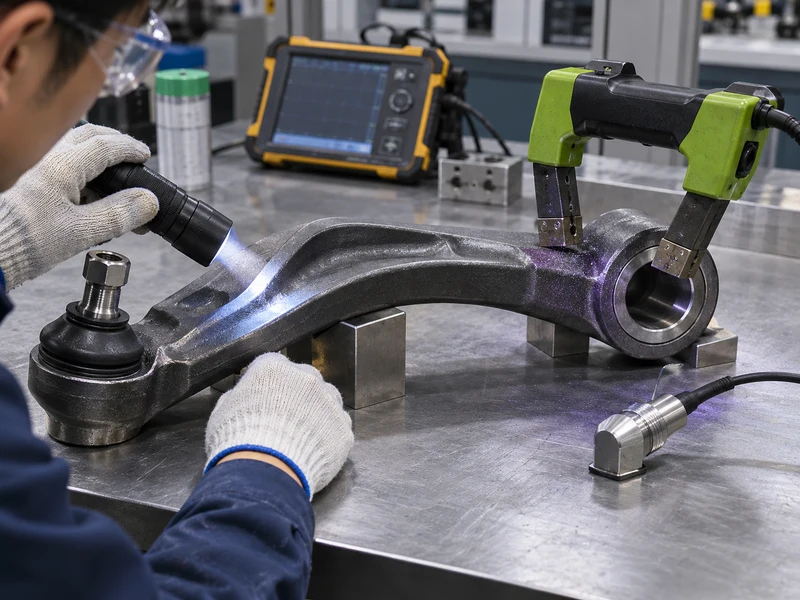
Fatigue cracks may initiate at discontinuities or highly stressed regions and grow under repeated loading.
When sourcing forged steel control arms, inspect the following areas before accepting a production batch.
Inspection Item | Potential Risk | Verification Method |
Forging laps and folds | Crack initiation | Visual inspection and specified magnetic particle testing |
Surface cracks | Progressive fatigue damage | Suitable crack detection |
Internal discontinuities | Reduced structural integrity | Ultrasonic testing where applicable |
Surface decarburization | Reduced surface fatigue resistance | Metallographic examination |
Incorrect heat treatment | Unsuitable strength or toughness | Hardness and specified mechanical tests |
Incorrect fillet radius or section thickness | Increased local stress | Drawing-based dimensional inspection |
During vehicle service, cracks around mounting points, permanent deformation or severe section loss from corrosion require professional assessment.
Suspension noise, steering instability and uneven tire wear may indicate suspension problems, but they cannot independently establish a forging defect.
A suspected structural crack or permanent deformation requires the vehicle to be taken out of service until professionally inspected.
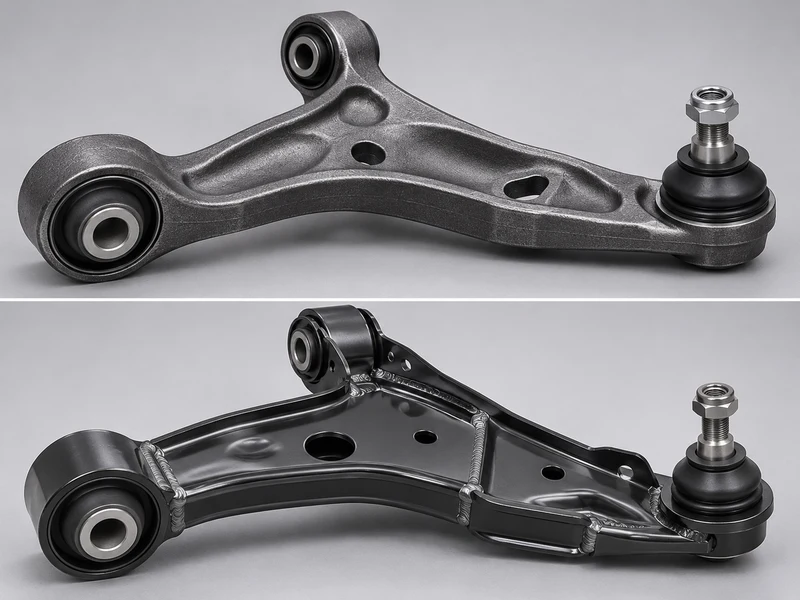
A one-piece forged arm body can avoid the structural weld seams found in some stamped assemblies. Stamped designs can also achieve the required durability through suitable geometry, steel selection and controlled joining processes.
A 2023 study published in Metals examined SAE 1045H steel using rotating-bending fatigue tests.
The researchers applied a load of 500 ± 50 N, positioned 80 mm from the clamping system, at a frequency of 8.33 Hz. Five specimens were tested in each configuration.
Specimen | Manufacturing Condition | Mean Cycles to Fracture | Standard Deviation |
A | Forged, longitudinal grain-flow configuration | 24,400 | 5,176 |
B | Forged, transverse grain-flow configuration | 10,500 | 7,357 |
C | Machined from rolled steel bar | 11,400 | 6,076 |
Source: Suris, Yurgel and Alves de Sousa, Metals, 2023, 13(2), 187, Table 6.
Configuration A achieved the highest mean fatigue life among the tested groups. The substantial standard deviations also demonstrate variability within the small specimen groups.
These figures are material-specimen results, not service-life ratings for forged steel control arms. They support the importance of grain-flow orientation but do not establish a universal durability advantage over stamped control arms.
A 2014 automotive control arm failure study identified fatigue cracking near a weld initiation point in a stamped, robot-welded steel assembly.
Local stress concentration and excessive initial welding heat were associated with the failure. A revised welding procedure enabled the component to meet its specified fatigue-test requirement.
This example illustrates why production quality matters regardless of the manufacturing route.
Direct comparisons between forged steel control arms and stamped alternatives require equivalent component-level test conditions.
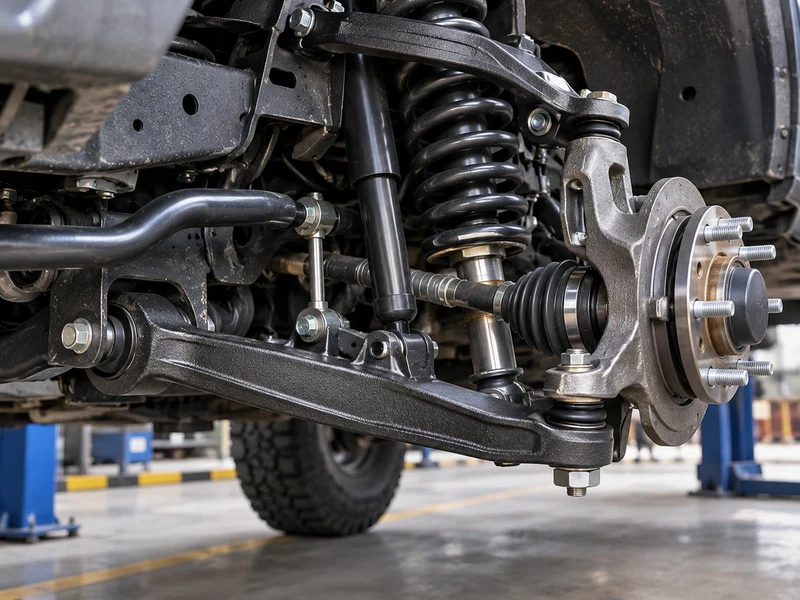
Forged steel construction may be considered when a suspension design must withstand demanding cyclic loads. The suitability of a specific arm must still be established through vehicle fitment and structural validation.
Application | What Buyers Should Verify |
Commercial vehicles | Vehicle load requirements and duty cycle |
Pickups and SUVs | Mounting geometry, joint articulation and durability |
Rough-road operation | Impact loads, fatigue resistance and corrosion protection |
Modified suspension | Changed geometry, travel and component interference |
Lightweight passenger vehicles | Mass, packaging and original performance requirements |
Standard aftermarket replacement | OE fitment and validated replacement performance |
Do not assume that forged steel control arms are interchangeable with stamped or aluminum alternatives simply because their mounting points appear similar.
Ball joint travel, bushing stiffness, wheel clearance and suspension movement must remain compatible with the vehicle design.
For additional material-selection considerations, see Aluminum vs Steel Control Arms.
IATF 16949 addresses automotive quality management systems. PPAP supports production part approval when required by the customer. Neither independently establishes the load capacity or fatigue life of a control arm.
Depending on the purchasing program, buyers may request the following documentation for forged steel control arms:
Steel grade and material certificates.
Heat treatment and hardness records.
Dimensional inspection and specified NDT reports.
Component-level structural and fatigue test reports.
Material and production batch traceability.
Customer-specific approval documents.
Applicable export-market regulations and customer specifications must be reviewed separately. There is no universal fatigue-cycle requirement for every control arm design.
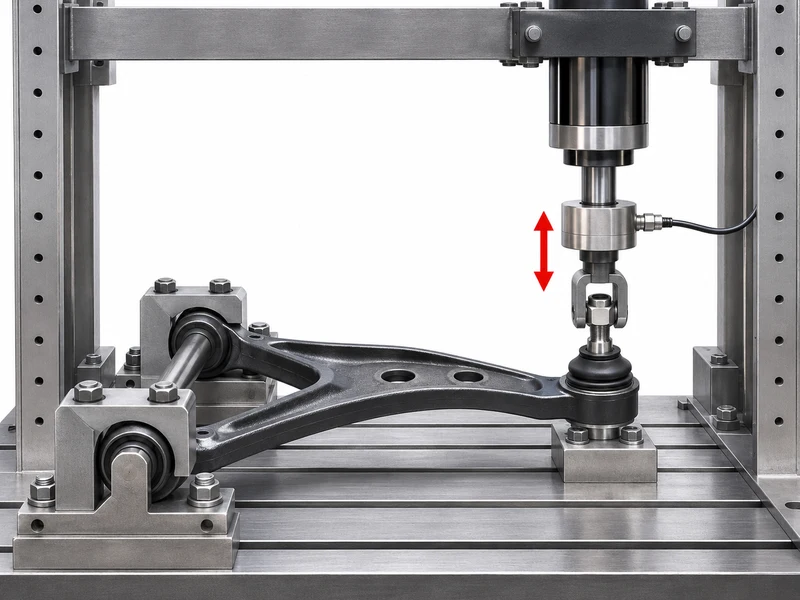
A high fatigue-cycle count is meaningful only when the test conditions and acceptance criteria are known.
Report Item | Required Information |
Test samples | Part number, drawing revision and sample quantity |
Applied loads | Minimum and maximum loads, directions and loading sequence |
Test arrangement | Mounting points, fixtures and boundary conditions |
Cycle count | Required and completed cycles |
Acceptance criteria | Specified limits for cracks, deformation or stiffness changes |
Test result | Failure, completed test without failure, or another defined termination condition |
If a sample completes the required cycles without failure, the report establishes survival under those test conditions. It does not establish the maximum fatigue life or equivalent road mileage.
Select forged steel control arms using evidence tied to the actual part number, vehicle application and durability requirements.
For wholesale or vehicle-specific suspension projects, browse the Part-Industry control arm range.
Send Part-Industry your OE numbers, drawings, vehicle applications, operating conditions, estimated quantities and required durability specifications to confirm product availability and project feasibility.
Submit Your Control Arm Requirements


